

Welcome back to the AI Edge weekly newsletter!
Anthropic just extended access to Fable 5 through July 12th. In this publication, we’re giving you our ultimate Fable 5 guide so you can maximize your usage over the next five days.
We’ll cover:
How to Effectively Prompt Fable 5
How to Cut Token Spend
Loop Engineering 101
3 Real Fable 5 Workflows (prompts included)
After our main anchor piece, be sure to stick around for the Midweek Edge for the latest AI news, and our Looking Ahead section, where we compile our top AI research.
We also have a special announcement (spoiler: we are hiring) - stick around for the details!
Let’s get right into things!
How to Effectively Prompt Fable 5
Fable 5 doesn't respond to prompts the way other Anthropic models do. Fable is specifically built for fully autonomous, “looped” work.
Here's how to adjust your prompting (advice sourced from Anthropic itself):
Effort level selection
Effort controls the trade-off between intelligence, latency, and cost.
We actually recommend sticking to Medium as your default, and only switching to Xhigh for your hardest problems.

Tell it why, not just what
Because Fable is built for autonomous work, it needs context to connect your task to the bigger picture so it can make decisions on its own - this is not a model where you just want to send instructions to follow.
Use this prompting formula:
"I'm working on [the larger task] for [who it's for].
They need [what the output enables].
With that in mind: [your actual request]."
Keep instructions short
Over-engineering prompts can actually hurt output quality.
We’ve found that a brief instruction often performs better than a long list of rules because you're constraining a model that is built to find the right approach on its own.
Schedule check-ins
Fable 5 is designed to run long sessions, and can even run fully autonomously by default with loops (more on /loop later).
Because of this, you want to set boundaries for your work to avoid Fable running off without your permission.
"Pause the work every [time interval] - give me a mini update
so I can ensure we are on the right track. If you need anything
from me, let me know so I can steer us in the right direction."
Give Fable a memory system
Fable 5 performs better when it can log lessons across runs. You can use this data to create loops that then create self-evolving workflows.
How to build a memory system with Fable
Download the Obsidian Desktop app
Create a new Vault labeled “Fable 5 session logs”
Attach the Vault in Cowork or Claude Code with this instruction:
“Every single day, I want you to automatically update and maintain my markdown file system to create a running log of all my preferences.”
Work
Now, whenever you work with Fable, attach your markdown file system, and it will update automatically based on your workflow preferences.
How to Cut Token Spend With Fable
Fable 5 is exactly twice the cost of Opus 4.8 - and because it's smart enough to overthink, it can burn through tokens fast if you're not careful.
Here's the system to keep costs under control straight from Anthropic engineers:
10-80-10 System
We highly recommend implementing a 10-80-10 prompt engineering system when using Fable.

Use Fable only where it actually earns its cost:
The first 10%: Planning
Use Fable to define the structure, approach, success criteria, and constraints of your project upfront. Think of it as the architect who needs to get the plan right before anything gets built.
The middle 80%: Execution
Hand the actual grunt work to a cheaper model (Opus 4.8 or Sonnet is a good option). This is where most tokens get burned, and it's overkill to pay Fable prices for it.
The final 10%: Review
Bring Fable back to check the finished output against the original plan.

Loops for Efficiency
There are two ways to run autonomous loops with Fable:
/goal: Perfect for tackling single tasks (think: research, simple tasks with a single outcome).
/loop: How to run Fable on a schedule or for deep, complex tasks.
/loop [your prompt] --interval 30m --expires 8hCombine loop engineering with the 10-80-10 system: Fable architects the loop, a cheaper model executes it, and Fable steps back in only when the loop closes or when something needs review.
Other General Token-Saving Tips We’ve Found Helpful
Don’t fear “low” effort. Fable on low effort often beats other models on High.
Delete old Skills and instructions. Prompts built for older models often perform worse (and cost more) in Fable. Either have Fable optimize your existing Skills, or build them completely from scratch.
Run /usage regularly. Use this command to monitor your spend, especially when Fable moves to pay-per-token access.
Two Costly Mistakes to Avoid
Running Fable by accident. Claude now defaults to Fable when you open the app. Check the model selector before every session.
No spending cap. Fable can rack up a bill fast on autonomous runs. Set your limit under Settings → Usage → Adjust Limit in Claude.

Loop Engineering 101
As the builder of Claude Code (Boris Cherny) put it, he doesn't prompt Claude anymore; he writes loops that prompt Claude for him.
There Are Six Parts of Every Fable Loop
1. Trigger: What starts the loop. Usually /schedule or /loop.
2. Execution Layer: Where the actual work happens (no manual intervention needed here).
3. The Verifier: A checkpoint that confirms Claude is on track.
4. Stop Rules: Every loop needs a success condition and a failure condition.
"Max 20 attempts. If all tests pass, report TASK_COMPLETE
and stop. If unresolved after 3 retries, report TASK_FAILED
and stop."
5. Memory: A markdown progress file logging what's been done - which we covered above.
6. Skills (CLAUDE . md): Saved instructions that freeze project context so the agent doesn't relearn it every run.

Putting It All Together
/loop [verifiable end state], only touching [scope],
stop after [X] iterations, use [skill] for verification,
and keep a memory file of all your work.
Pro Tips
Start with /goal before /loop
Focus your time on defining the deliverable end-state
Always cap iterations and dollar budget before every run
Loops aren't just for code - we often use them for writing, research, and any repeatable task
3 Real Fable 5 Workflows (prompts included)
Now that you understand the basics of Anthropic’s Fable model, here are three workflows that everyone should set up while it’s still in subscription plans.
Workflow 1: Build a Personal OS Dashboard
Fable's ability to run long, autonomous sessions makes it perfect for building yourself a full personal command center in one sitting with no iteration required.
"I'm working on a personal OS dashboard for myself.
I want a single web app that pulls together my calendar,
tasks, and daily priorities into one clean view.
Request: build a personal dashboard web app with a calendar
view, a task list with priority tags, and a notes section,
using a clean minimal dark UI. Output format: a fully
functioning web app with all three sections on one page.
Constraints: don't add any features beyond these three
sections, keep the file structure simple, and pause only
if you hit a decision that changes the scope."
Workflow 2: Multi-Agent Coordination
Fable 5 can manage 50+ subagents at once, each starting with a fresh context window.
Instead of one Fable agent trying to do everything, you split the work amongst cheaper models and let Fable coordinate.
"I'm working on [your project] for [who it's for].
Request: break this task into parallel workstreams
and launch a subagent for each one — [list the workstreams,
e.g. research, drafting, fact-checking, formatting].
Each subagent should work independently with a fresh
context window. Output format: once all subagents complete
their work, consolidate everything into one finished
deliverable and flag any conflicts or overlaps between what
each subagent produced. Constraints: don't let subagents
duplicate work, and check in with me only if two subagents
produce contradictory results."
Workflow 3: Overnight Research Loop
This is the workflow Anthropic engineers use for fully autonomous overnight research.
Set it running before bed. Wake up to a finished, cited brief.
"/loop every 30 minutes, only touching /research/brief.md,
stop after 10 iterations or if the same search query appears
3 times in a row without new information surfacing,
use a verify-research skill after each section is drafted
to confirm every major claim has a source and every section
has at least 3 supporting data points, use a verifier agent
to check source quality and coverage completeness at the
halfway point and before final submission, and keep a memory
file at /research/progress.md that logs what sections are done,
what sources have been used, and what angles still need coverage. Topic: [your research topic]"
Before running this, set up two things:
CLAUDE . md: Including your research rules, session budget, and overall scope.
The verify-research skill: Confirms every claim is sourced and every section has enough supporting data before it's marked complete.
Quick Recap of How to Use Fable 5
Prompting: Match effort to the task, tell Fable why (not just what), keep instructions short, and set check-in intervals so it doesn't run off without you.
Cutting Token Spend: Use the 10-80-10 system: Fable plans, a cheaper model executes, Fable reviews. Combine with loops for maximum efficiency.
Loop Engineering: Every loop needs six parts (trigger, execution, verifier, stop rules, memory, and Skills).
3 Workflows to Try: A personal OS dashboard, multi-agent coordination for complex projects, and an overnight research loop that hands you a cited brief for any project by morning.
Get this right in the next five days while it's still on subscription plans, and you’ll take full advantage of the best AI model ever deployed.
We are hiring
If you’re passionate about AI and want to join one of the fastest-growing AI media companies, we may have a role for you.
We are looking to bring two special people onto the team:
Content Writer
We are looking for an AI-native copywriter. If you understand AI and can write, we want you on our team.
Full details & application.👇
AI Edge Researcher & Analyst
This is a special role for those who love building with AI. You will build AI workflows from scratch and share them with our community.
Full details & application. 👇
Midweek Edge
Our manually curated list of the most important news updates across AI, robotics & tech.
OpenAI Announces GPT-5.6 Family
It’s official. This Thursday, the GPT-5.6 model package, including GPT-5.6 Sol, Terra, and Luna, will be live for public access!
These models are expected to crush even Claude Fable 5!

NEW: Anthropic Research
The first signs of "consciousness" in AI?
Anthropic built a new tool to peek inside modern LLMs to see what they're "thinking."
It’s called a "Jacobian lens,” and Anthropic researchers found that their AI models have
a "workspace" where they think.
Simple analogy: Imagine your brain has a "mental notepad" where you jot down the 3-4 things you're actively juggling in conscious thought.
This new tool finds LLMs seem to have something like that notepad too: a small, privileged workspace of "active thoughts" floating around.
Anthropic doesn't claim LLMs are conscious, but this is interesting to think about...

WeaveRobotics launches Isaac 1
WeaveRobotics just launched its Isaac 1 robot. It costs only $8,000, and pre-orders are available now.

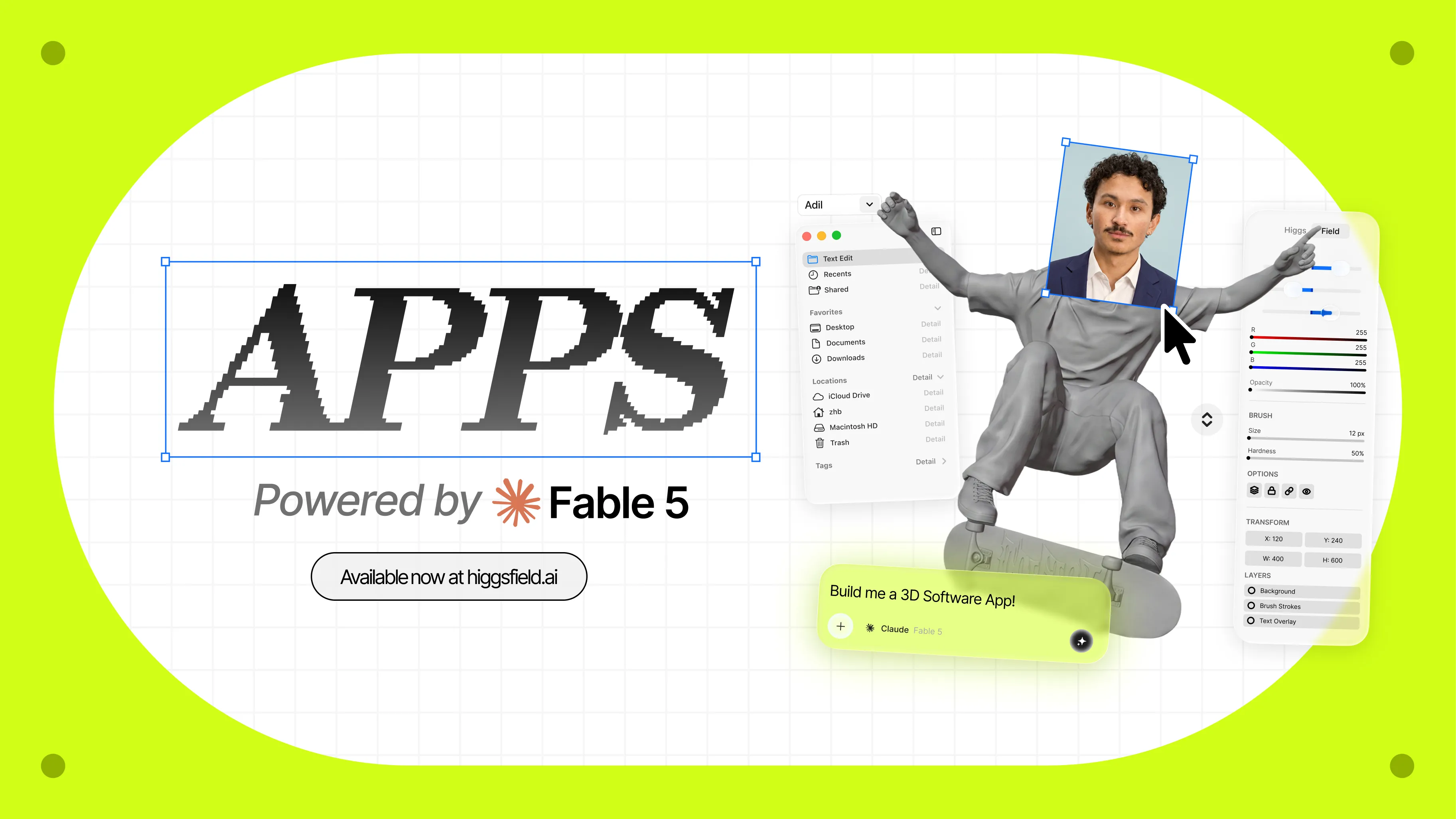
Higgsfield Apps
Higgsfield just launched a new way to build full-stack apps with Fable 5:
Available on Supercomputer and on Claude via Higgsfield MCP here:

SpaceXAI and Grok 4.5
SpaceX has officially merged as SpaceXAI. It’s part of Elon’s plan to merge all his major companies.
Grok 4.5 will always be live starting July 7th:
- Opus-class model
- Faster performance
- More token-efficient
- Lower cost

Looking Ahead
Our manually curated list of the top AI trends, research, workflows & more.
Robotics Research by Miles
The robotics sector has seen a massive increase in venture capital interest in Q2 ($16B in total investments).
If you’re interested in how to invest in this sector, Miles recently published his full guide to investing in robotics:

Model Research
Our internal research shows that in less than 12 months, we'll likely have a model 2x more powerful than Fable - and that might be the conservative estimate.
Here's why:
The best single measure of AI capability is Epoch's Capabilities Index (ECI)
(a composite score across 40+ benchmarks - math, coding,
science, reasoning).
When Fable was released, it hit a new high of 161 on the ECI.
The rate of frontier improvement nearly doubled around April 2024, from about 8 points per year to 15.
That faster pace has held across every single quarterly measurement cycle since then and is now the trend.
So, in theory, the trend that's held since 2024 just needs to continue in post-Fable 5 model releases, and the floor in 12 months is a 2-3x improvement in model capability.

Closing out
If you made it this far, thank you for reading, and we hope you found this week’s edition valuable.
If you enjoy reading, please forward our newsletter to someone you think would benefit from it.💙
Our promise to you: Every Wednesday, at 7 am EST, we’ll cut through the AI noise and send you human-curated AI content to make sure you stay ahead.
Content Pipeline
YouTube
Live Now: Do THIS with Fable now!
X (Twitter)
Live Now: Fable 5: A Beginner’s Guide to Loop Engineering
Free AI Asset Library
For all the AI prompts, cheatsheets, and PDF guides mentioned on the AI Edge YouTube channel, grab them by browsing our free assets library here:
See you next Wednesday!
Interested in sponsorship or a partnership? Get in touch at [email protected]